

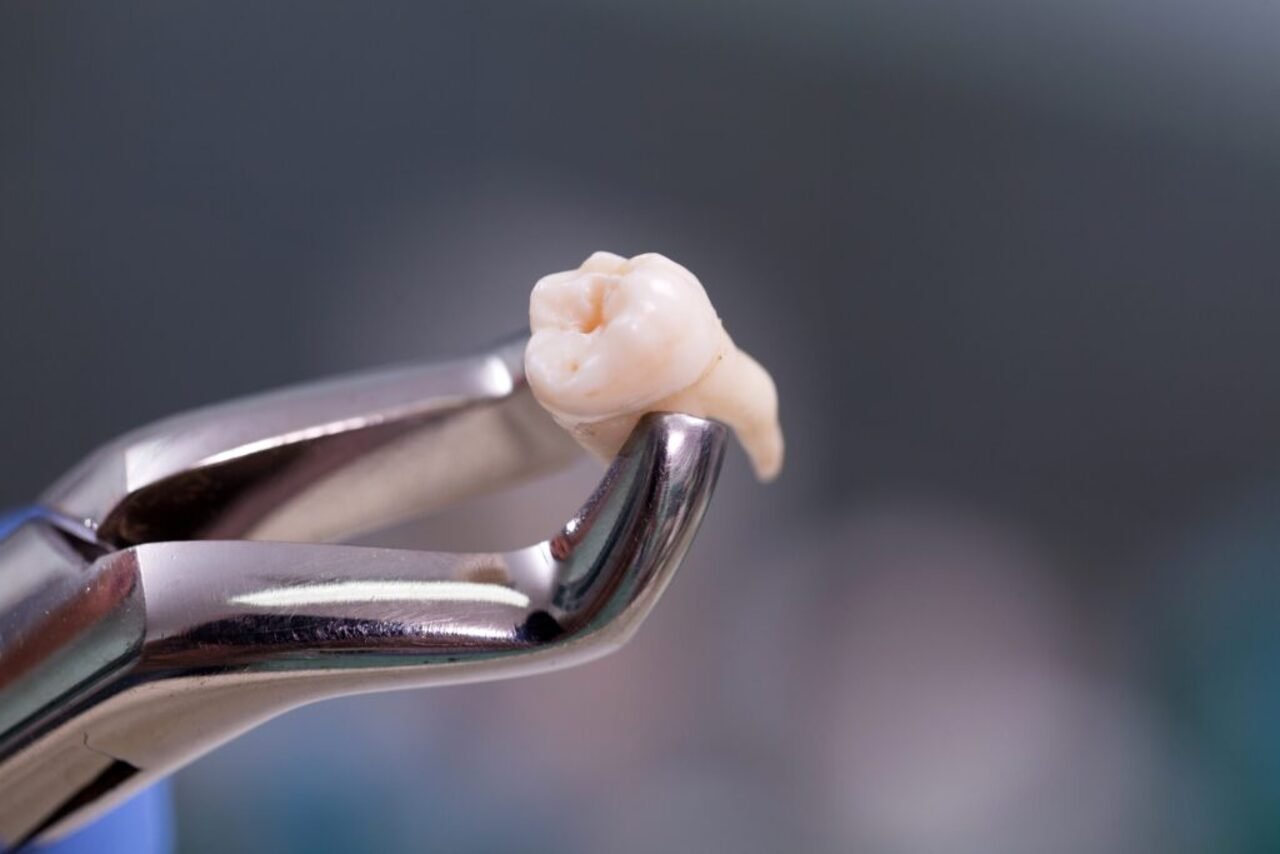
You went in expecting a tooth to be pulled. You came out with an appointment for surgery. That sentence describes a lot of first visits to the dental clinic, and the word “surgery” does most of the damage. It makes it seem as though something has gone wrong, that your case is actually unusual, that a seemingly straightforward problem has become a complicated one.
Usually none of that is true. In Malaysian dentistry, surgical extraction is routine. It describes a technique, not a crisis. And in many cases, the surgical approach is the gentler one, chosen precisely because forcing the tooth out the ordinary way would cause more harm.
Let us explain to you the difference between the two procedures, how your dentist decides which you need, what each one feels like, and how recovery differs between them.
You Do Not Choose. The X-Ray Chooses.
Patients often assume the two procedures are options presented for their consideration, like choosing between a filling and a crown. They are not. Which technique your dentist uses is determined almost entirely by what is happening beneath your gum line, and that is only visible on a radiograph, a.k.a. the dental x-ray the doctor uses to scan your teeth.
A tooth that looks perfectly normal from above can have roots that curve like a fish hook around the jawbone. A tooth that looks half-destroyed can lift out cleanly in ninety seconds. What you can see on the surface often tells you very little.
This is why a dentist cannot quote you accurately over the phone, and why any clinic that gives you a firm price for an extraction before examining you is just guessing.
What Makes an Extraction Surgical?
There are four things that make it necessary to have a tooth extraction become surgical:
The Tooth is Broken at The Gum Line
Forceps need something to grip. When decay or fracture has taken the crown, there is nothing above the gum to hold, so the dentist must uncover what remains.
The Roots are Curved, Splayed, or Fused to Bone
Straight roots slide out along their own axis. Curved ones cannot, and pulling harder does not help. It fractures the root and leaves fragments behind.
The Tooth is Impacted
Impacted means the tooth has not fully erupted, whether it is buried in bone, trapped under gum, or wedged against the tooth in front of it. Lower wisdom teeth are the classic example.
The Tooth Sits Close to a Nerve or the Sinus
Lower molars, particularly third molars, often sit near the inferior alveolar nerve, which supplies sensation to the lip and chin. Upper molars can sit against the floor of the maxillary sinus. In both cases, controlled surgical access is safer than force.
Notice what all these factors have in common. None of them is about how bad your tooth is. They are all about how the geometry of your teeth have formed.
What Happens in a Non-Surgical Extraction
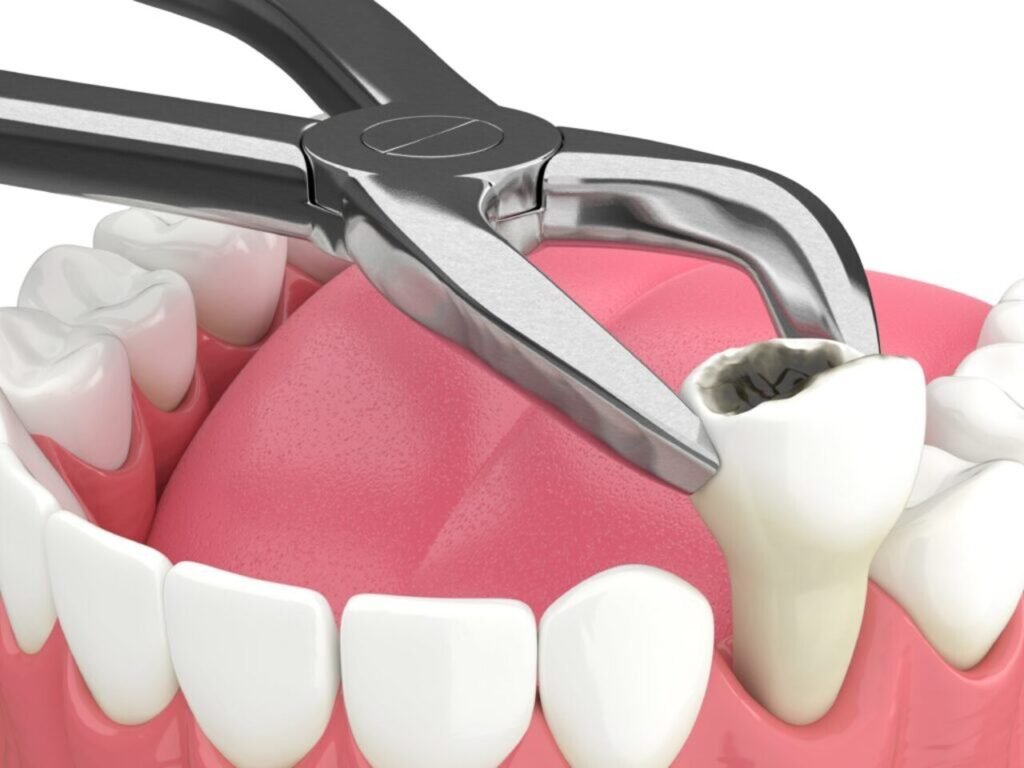
A non-surgical extraction is also called a simple extraction, though the word “simple” describes the dentist’s task rather than your experience of it.
The tooth is fully erupted, reasonably intact, and reachable. Your dentist numbs the area with local anaesthetic and waits for it to take full effect. Then, using an elevator, a small lever-like instrument, they widen the socket and break down the fibres holding the tooth in place. Once it is mobile, forceps do the rest.
You will feel firm pressure and hear sounds you would rather not. You should not feel pain. If you do, say so, because it means the anaesthetic needs topping up, not that you must endure it.
Most simple extractions take between ten and thirty minutes from injection to gauze.
What Happens in a Surgical Extraction
A surgical extraction is like a regular extraction with the same anaesthetic, but with more steps.
Your dentist lifts a small flap of gum tissue away from the bone to expose the tooth. Where the tooth is buried, a small amount of overlying bone may be removed. The tooth is then loosened and lifted out, and the gum is repositioned and closed with sutures, often the dissolving kind.
One additional step deserves explaining, as it is a step that alarms patients when they hear it described.
Sectioning: Why the Dentist May Cut your Tooth Into Pieces
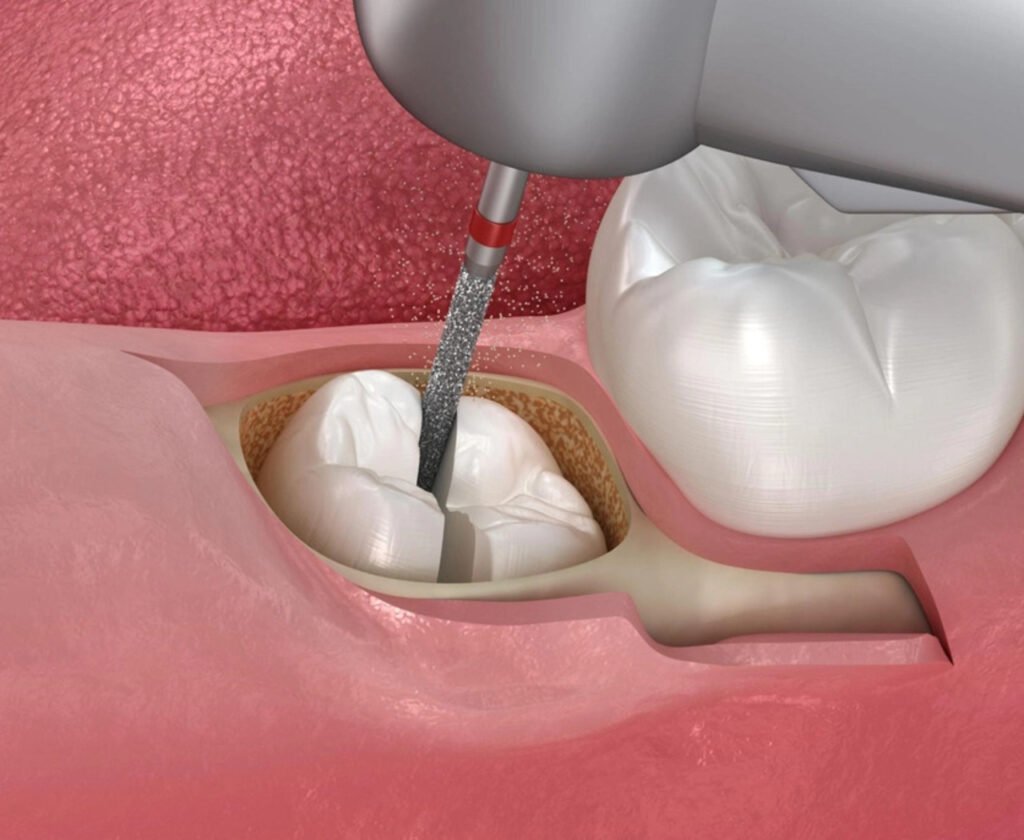
If a tooth has divergent roots, removing it whole means dragging the whole shape through an opening it does not fit. That takes force, and force is what fractures bone and damages neighbouring teeth.
So instead, the tooth is divided. Each root is removed separately, along its own path, with far less pressure. The socket is smaller, the surrounding bone is preserved, and healing is better. It sounds more invasive at first. However, having it done this way is considerably less traumatic. This is the clearest illustration of why “surgical” does not mean “worse.”
So Is Surgical Extraction More Painful?
During the procedure, it is not. Both procedures are performed under local anaesthetic, so neither should hurt. Afterwards though, you may feel some moderate pain. More tissue was involved, so there is more to heal. After a non-surgical extraction, expect discomfort peaking on the first day, resolving over roughly three to five days. Most people return to work the next day and eat normally within a week.
After a surgical extraction, expect swelling that peaks around forty-eight to seventy-two hours, not immediately. Bruising is possible. Jaw stiffness is common. Discomfort typically settles over seven to ten days, and the socket itself takes several weeks to fill in properly.
The counterintuitive part is that day two often feels worse than day one. That is normal, expected, and not a sign that something has gone wrong.
Dry Socket, and How to Avoid It
After any extraction, a blood clot forms in the socket. It is not debris; it is the scaffold your body builds new tissue on, and it covers exposed bone and nerve endings.
If that clot dislodges, you get a dry socket. It usually announces itself three to five days afterwards as a deep, throbbing ache that painkillers barely touch, often radiating to the ear, sometimes with a foul taste. It is more common after surgical extractions and after lower wisdom teeth.
Four things dislodge clots: smoking, drinking through a straw, vigorous rinsing or spitting in the first twenty-four hours, and poking the site with your tongue. Avoiding all four is the whole of prevention. If the clot dislodge happens, return to your dentist. It is uncomfortable rather than dangerous, and it is treatable in a single visit.
Who Performs Each Procedure?
Both surgical and non-surgical extractions are performed by general dentists every day. Surgical extraction sits within the scope of general practice and does not automatically require a specialist.
What prompts a referral to a specialist in oral surgery is the specific difficulty of your case, not the label attached to the technique. A lower wisdom tooth sitting directly on the nerve, a root fractured deep in the sinus, or a patient with a medical history that complicates bleeding or healing are all reasons to involve someone with additional surgical training.
We would rather refer you than attempt something we should not. If we do refer you, we will tell you exactly why.
What "Minor Oral Surgery" Means on a Price List
Malaysian clinics commonly file surgical extraction under a heading called oral surgery or minor oral surgery. This confuses patients who assume they are being upsold into a different category of treatment. They are not. It is only a billing classification. A surgical extraction is oral surgery in the same way that a filling is restorative dentistry. The word describes what is being done, not how serious your situation has become.
What This Costs in Malaysia
Cost tracks complexity, and complexity is only visible on the X-ray.
A non-surgical extraction is among the most affordable procedures in dentistry. A surgical extraction costs meaningfully more, because it takes longer, requires sutures, and sometimes requires imaging beyond a standard film. An impacted lower wisdom tooth sits at the upper end of that range.
Government dental clinics charge heavily subsidised rates for Malaysian citizens, with longer waits for non-urgent cases. Private clinics cost more and see you sooner.
What you should insist on, in either setting, is a written quotation after your examination, not before it. Ask what is included. Consultation, X-ray, anaesthetic, the procedure, medication, and the post-operative review are frequently priced separately, and a quote that omits three of those is not a quote.
When Extraction Is the Wrong Answer
A tooth that can be saved should usually be saved. Root canal treatment followed by a crown preserves a natural tooth root, and a natural root maintains the bone around it in a way no replacement quite does. Extraction is cheaper on the day and frequently more expensive over a decade, once you account for the implant or bridge that follows.
There are teeth that cannot be rescued. Vertical root fractures, teeth destroyed below the bone, teeth with severe periodontal bone loss. There are also teeth that are healthy but must go, to create space for orthodontic treatment.
But if you have been told a tooth needs removing and nobody has explained why saving it is not possible, ask. A dentist who has thought carefully about your case will have a clear answer ready.
Frequently Asked Questions
Not during the procedure. Both are done under local anaesthetic and neither should hurt. Recovery differs: discomfort after a simple extraction typically settles within three to five days, while a surgical extraction usually takes seven to ten days, with swelling peaking around the second or third day rather than immediately.
This is called sectioning, and it is done when a tooth has curved or divergent roots. Removing each root separately along its own path requires far less force than pulling the whole tooth through a socket it does not fit, which protects the surrounding bone and neighbouring teeth. It sounds more invasive but is gentler.
Usually not. General dentists perform surgical extractions routinely. Referral to a specialist depends on the specific difficulty of your case, such as a wisdom tooth sitting very close to the inferior alveolar nerve, a fractured root near the sinus, or a medical history that complicates surgery.
Your dentist decides after examining you and reviewing an X-ray. Four things typically make an extraction surgical: the tooth is broken at the gum line, the roots are curved or fused to bone, the tooth is impacted, or it sits close to a nerve or sinus. None of this is reliably visible without imaging.
Dry socket occurs when the blood clot protecting the extraction site dislodges, exposing bone and nerve endings. It typically appears three to five days afterwards as a deep ache that painkillers do not relieve. Avoid smoking, straws, vigorous rinsing, and touching the site for the first twenty-four to forty-eight hours.
No. A fully erupted, upright wisdom tooth with accessible roots can often be removed with a simple extraction. Impacted or partially erupted wisdom teeth, particularly lower ones, usually require the surgical approach.
Surgical vs Non-Surgical in a Nutshell
Non-surgical extraction removes a tooth you can see. Surgical extraction reaches a tooth you cannot, through a small incision and sometimes by dividing the tooth so it comes out along the path of least resistance. Neither hurts at the time. The surgical version takes longer to heal. The choice between them was made by your anatomy long before you sat down. If you are facing an extraction and are unsure what you are actually being offered, ask which of the four criteria applies to your case. It is a fair question and the answer should be a straightforward one.
Get a Tooth Extraction at Cozy T Dental Seremban
At Cozy T Dental, extractions begin with an assessment, not an assumption. We examine the tooth, review the X-ray, and explain which of the four criteria applies to your case before any decision is made about how it comes out. Both simple and surgical extractions are performed here as part of our routine oral surgery care. Where a case calls for specialist involvement, we say so, and we tell you exactly why.
You are welcome to ask questions at any stage. Understanding what is happening to your tooth is part of the treatment, not an optional extra.