

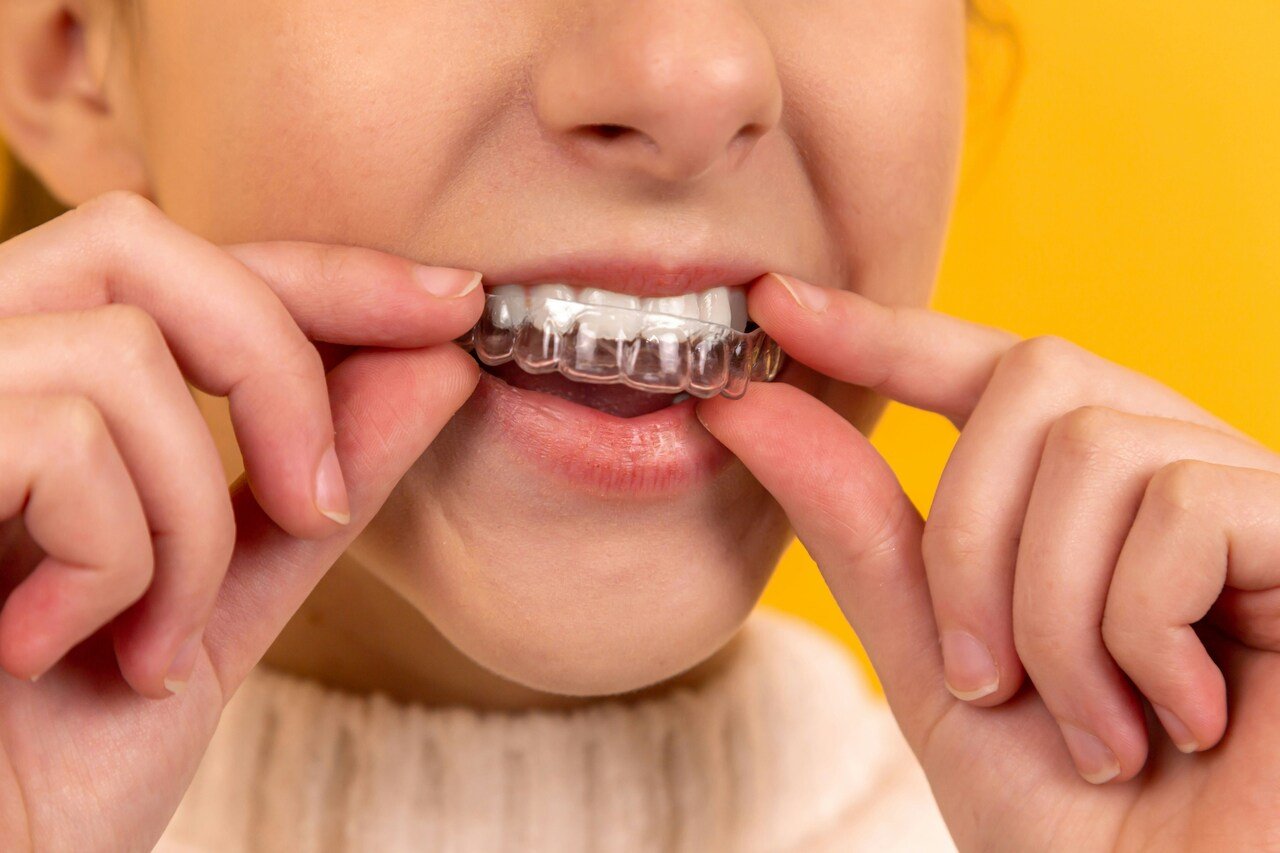
Yes, clear aligners work for mild to moderate cases, when prescribed and monitored by a registered dentist, and worn 20 to 22 hours a day. So of course clear aligners work; they have a substantial body of clinical research behind them, they resolve most of the cases they are prescribed for, and for a great many adults they are the more comfortable option.
But they work under conditions. Just because a vast majority of aligners providers say yes, it doesn’t mean a foolproof guarantee – it comes to a point that sounds less like evidence and more like sales. Those conditions are the part that rarely makes it into the marketing.
Here we will uncover what the research actually found, which cases aligners handle well, which ones they handle poorly, why supervision matters more than brand, and what happens after treatment ends.
What Are Clear Aligners, and How Do They Move Teeth?
Clear aligners are a series of custom-made transparent trays, worn in sequence. Each tray is shaped slightly differently from the position your teeth are in now, and that small mismatch applies gentle, continuous pressure. Bone remodels around the moving tooth. You change trays every one to two weeks, and each one asks for a little more.
That is the whole mechanism. It is the same biological process as braces, delivered by a different appliance.
Why "Invisible Braces" Is a Slightly Misleading Name
The term is everywhere, and it does the technology no favours. Aligners are not braces. Braces are fixed, which means they work whether or not you cooperate, and they grip each tooth individually through a bracket, which gives an orthodontist fine control over rotation and angulation.
Aligners are removable, which is their greatest advantage and their only real weakness, and they move teeth by enveloping them rather than gripping them. Understanding that difference explains almost everything that follows.
Do Clear Aligners Work as Well as Braces?
For most cases, yes: clear aligners can work just as well as braces for straightening teeth. But for some specific movements, no. The honest answer requires knowing both sides.
What the Research Says They Do Well
A 2025 systematic review and meta-analysis from the University of Manchester, published in the Journal of Evidence-Based Dental Practice, pooled 21 randomised controlled trials covering 970 patients. It found no significant difference between clear aligners and fixed braces across three standard measures of orthodontic outcome.
The same review found significantly lower plaque, gum, and bleeding scores among aligner patients, and better reported quality of life at six months. Which makes intuitive sense. You can take them out to brush properly.
A systematic review in BMC Oral Health, covering eight comparative clinical studies, concluded that both aligners and braces were effective at treating malocclusion, and that aligners held advantages in segmented tooth movement and shorter treatment duration.
What the Research Says They Do Less Well
That same BMC Oral Health review concluded that braces were more effective at producing adequate occlusal contacts, controlling tooth torque, increasing transverse width, and retention. Its authors note that aligners cover the biting surfaces of the teeth, which prevents the bite from settling naturally. Torque control means the angle of the root inside the bone. Occlusal contact means how your upper and lower teeth meet when you bite. These are not cosmetic details. They are the difference between teeth that look straight and a bite that functions.
None of this means aligners fail. It means they have a domain. Inside it, they perform excellently. Outside it, a bracket and wire will serve you better, and any dentist who tells you otherwise is selling rather than diagnosing.
A systematic review in the Angle Orthodontist from the University of Turin mapped how accurately aligners perform each type of tooth movement. Aligners control anterior intrusion and the tilt of back teeth, and move upper molars backwards with high predictability, around 88% accuracy for movements of roughly 1.5mm. What they struggle with is extrusion, pulling a tooth down out of the bone, which was the least predictable movement at about 30% accuracy, followed by rotation, particularly of rounded teeth such as canines and premolars. The authors recommend aligners for simple malocclusions. This is not a flaw. It is a specification.
Which Cases Do Clear Aligners Actually Work For?
Good Candidates
Aligners perform reliably for mild to moderate crowding, spacing and gaps, mild rotations, and straightforward bite corrections. Adults and teenagers with fully erupted permanent teeth and healthy gums are the core group.
Borderline Cases
Moderate crowding with some rotation, mild to moderate overbite or underbite, and cases requiring limited tooth extraction sit in the middle. These are treatable with aligners in skilled hands, often with the help of attachments, which are small tooth-coloured bumps bonded to the tooth to give the aligner something to push against.
When Braces Remain the Better Choice
Cases where braces are better include:
- Severe crowding.
- Significant skeletal discrepancies.
- Complex bite problems requiring precise vertical control.
- Cases needing substantial root movement or extraction space closure.
If your case falls here, we will tell you. Recommending aligners to someone who needs braces produces a slow, expensive, disappointing eighteen months, and then a conversation about braces anyway.
The Thing That Decides Whether They Work: You

Here is the answer that matters more than any study. Clear aligners do not work when they are sitting on your bedside table.
The prescription is 20 to 22 hours a day. That leaves roughly two hours for eating, drinking anything other than water, and cleaning your teeth. It is not a suggestion, and it is not a target to aim near. Braces work while you sleep, while you eat, while you forget about them entirely. Aligners are the only orthodontic treatment where the patient is part of the mechanism.
Most people manage it comfortably within a fortnight. It becomes automatic. But the honest question to ask yourself before you commit is not “can aligners fix this?” It is “will I actually wear them?”
What Happens When Aligners Stop Tracking
Wear them inconsistently and the tray stops fitting the tooth it is meant to be moving. Dentists call this a tracking failure, and you will see it as a small visible gap between the aligner and the tip of the tooth.
Once tracking is lost, the sequence breaks. Every subsequent tray was designed for a position your teeth never reached. Treatment stalls, and the usual remedy is a fresh scan and a new set of aligners, which costs time and, depending on your treatment plan, money.
This is why we check on you every six to eight weeks. Not to sell you anything. To catch that gap while it is still small.
Do Mail-Order Clear Aligners Work?
Direct-to-consumer aligners arrive by post after an at-home impression kit or a smartphone scan. No dentist examines you. Prices sit well below in-clinic treatment, and the appeal is obvious.
A study of the FDA’s MAUDE adverse-event database identified 104 reports linked to unsupervised direct-to-consumer aligners between 2018 and 2020. Bite problems accounted for 41.3% of them, orofacial pain 29.8%, and periodontal complications 26.6%. Almost 70% of those patients ended up seeking help from a dentist with no connection to the aligner company. The authors concluded that using these aligners without supervision by a licensed dental professional can lead to adverse outcomes, some of them irreversible.
The authors caution that these numbers are almost certainly an undercount. Reporting to the database is voluntary, and most of these reports came from patients rather than clinicians, because in the direct-to-consumer pathway there is no clinician there to notice
The problem is not the plastic. The trays themselves may be perfectly well made. The problem is that nobody looked in your mouth first. Nobody took an X-ray to check the bone supporting your teeth. Nobody noticed the gum disease, or the untreated decay, or the root that will not survive being moved. Moving teeth is a biological procedure performed on living bone, and it is not made safe by being convenient.
What Malaysian Regulation Says
This is now a live public conversation here. A commentary carried by BERNAMA noted that direct-to-consumer aligners are marketed in Malaysia at 30 to 60 per cent below in-clinic prices, and that Malaysian dental professionals are seeing increasing numbers of patients presenting with poor tracking, ill-fitting trays, and undetected periodontal problems.
It also set out the regulatory position clearly. Under the Dental Act 2018 and Malaysian Dental Council guidelines, orthodontic procedures are expected to involve registered dental professionals, and the Medical Device Authority classifies clear aligners as medical devices, with proper diagnosis and monitoring treated as essential components of safe treatment.
Before beginning any aligner treatment in Malaysia, confirm that a dentist registered with the Malaysian Dental Council is diagnosing your case, examining you in person, and monitoring your progress. If nobody will name the treating dentist, that is your answer.
The Cost That Is Not in the Price
Roughly a third of the reports in that MAUDE study described patients who then needed further treatment, including corrective orthodontics, gum therapy, or root canal work.
The BERNAMA commentary makes the point that when complications arise, patients often seek corrective treatment from registered orthodontists at a higher cost than properly supervised care would have been from the start.
A cheaper treatment that has to be redone is not cheaper.
Do the Results Last? Retention and Relapse
Teeth will drift. It is what teeth do, and it happens after braces just as it happens after aligners. Once your active treatment finishes, you move into retention, which means wearing retainers, usually nightly and usually indefinitely. Skip this and your teeth will gradually return toward where they started, which is the single most common reason adults find themselves considering orthodontic treatment for the second time.
The BMC Oral Health review reports one included study finding that after the retention period, aligner patients relapsed more in alignment than those treated with braces. Its authors suggest a mechanism: bone around a moving tooth needs roughly one to two weeks to repair, so the standard two-week aligner change may leave less recovery time than braces adjusted every four to six weeks. Retention is not the epilogue to your treatment. It is part of it.
What Clear Aligners Cost in Malaysia
Prices in the Malaysian market generally run from around RM7,000 at the lower end to between RM12,000 to RM25,000 for complex Invisalign cases, with most straightforward cases landing somewhere in the middle.
The range is wide, and the reason is worth understanding. Cost tracks case complexity and the number of aligners your treatment requires, far more than it tracks brand prestige. A simple gap closure needing twelve trays will always cost less than a moderate crowding case needing forty, regardless of the name printed on the box.
Be wary of a fixed headline price quoted before anyone has scanned your teeth. Nobody can price a treatment plan that does not yet exist. What you should expect is a scan, an assessment, and then a written, itemised quote that tells you what is included and whether retainers are extra. Ask specifically about retainers, as they usually cost extra.
Frequently Asked Questions
For overall tooth movement in suitable cases, research finds no significant difference between the two. Braces retain an advantage in controlling tooth torque, achieving precise bite contacts, and managing complex or severe malocclusions. For mild to moderate cases, aligners are a clinically sound choice.
Most treatments run between six and eighteen months, depending on complexity. You will usually notice visible movement within the first two to three months. Wearing them inconsistently extends the timeline, sometimes considerably.
Mild to moderate overbites, often yes. Significant skeletal overbites involving jaw position, usually not. This distinction can only be made after an examination and X-rays, which is one reason at-home aligner services cannot answer it.
Movement slows, and eventually the tray stops fitting the tooth it is meant to move. Once that tracking is lost, remaining trays no longer match your teeth, and treatment typically needs to be rescanned and restarted from your current position.
They carry documented risks. Adverse events reported to the FDA’s MAUDE database for unsupervised direct-to-consumer aligners were dominated by bite problems, orofacial pain, and periodontal complications, some of them irreversible. Under the Dental Act 2018, orthodontic treatment in Malaysia is expected to involve a registered dental professional.
Yes, and generally for life, usually worn overnight. Teeth relapse toward their original positions without retention. This applies equally after braces. Ask whether retainers are included in your quoted price, because they often are not.
So, Do Clear Aligners Work?
Yes, and the qualification is not a caveat buried in fine print. It is the answer. They work when your case falls within what the appliance does well, which covers the majority of adults who ask us. They work when a registered dentist has examined you, X-rayed you, and planned the movement before the first tray is made. They work when you wear them. And they last when you keep your retainers in.
Get those four things right and clear aligners are a comfortable, discreet, well-evidenced way to straighten your teeth. Get any one of them wrong and no brand, price, or technology will rescue the outcome.
Get Clear Aligners at Cozy T Dental Seremban

If you are wondering whether your teeth fall inside that range, the only way to know is to have someone look. At Cozy T Dental in Senawang, an assessment involves a scan, a proper examination, and a straight answer about whether aligners are right for you. Sometimes that answer is braces. We will tell you if it is.